

The Definitive Guide to Wooden Cutting Boards
How a board is built, what food-safety research can tell us, and how to choose and care for a work surface you’ll use every day.
Explore the guide ↓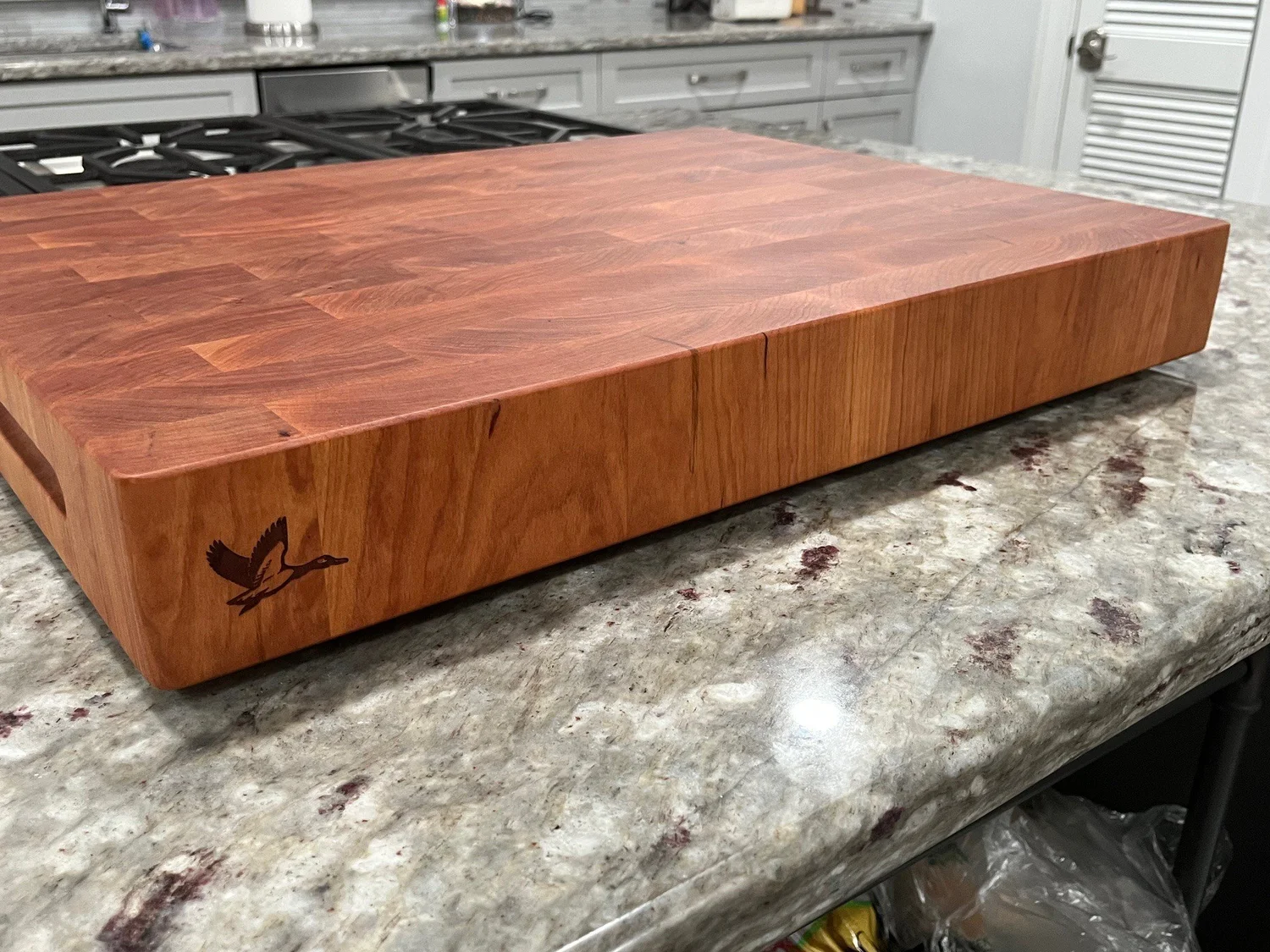
What makes a board worth keeping?
A good cutting board gives your knife room to work, stays steady on the counter, and fits the way you wash and store it. Those qualities come from decisions you can see and feel: how the wood is oriented, how flat the board sits, how the edges are finished, and how easily you can pick it up when it’s wet.
At Green Duck, we came to cutting boards through furniture-making. The same shop habits matter here: select sound hardwood, fit joints closely, allow for wood movement, and check the finished piece where it will be used. A substantial end-grain block can be a pleasure to leave on the counter. A lighter edge-grain board may be the one you reach for every morning. Both can be well made.
Wood, plastic, and a clean work surface
USDA household guidance allows wood or a nonporous surface such as plastic. It emphasizes keeping boards clean, using separate boards for raw animal foods and foods eaten without further cooking, and replacing surfaces that are too worn to clean effectively.[1][2]
What the experiments found
In two 1994 studies, Nese Ak, Dean Cliver, and Charles Kaspar inoculated small blocks cut from new and used wooden and plastic boards. Clean wood often took up the inoculated liquid quickly, and the researchers generally recovered fewer bacteria from wood. They also found that new plastic cleaned readily and that deep knife scars and residual chicken fat made worn plastic harder to clean by hand. Fat on wood also changed recovery under some test conditions.[3][4]
Recovery depends on how you look. A separate study by Abrishami and colleagues found viable E. coli within wood tissue under their test conditions. In a ground-beef experiment on unscored boards, Miller and colleagues found no significant material difference in recovered surface bacteria and little evidence of a general antimicrobial effect from water extracts of the hardwoods tested. In a simulated commercial wash-and-sanitize study, Welker and colleagues found the tested plastic boards cleaner by an ATP residue measure and occasionally recovered inoculated E. coli from wood after treatment.[5][6][7]
Plastic boards can shed particles during chopping. A 2023 experiment measured particle release from polyethylene and polypropylene boards under specific chopping conditions. The study measured release and included preliminary cell testing. It did not establish what health effects, if any, follow from ordinary kitchen exposure.[8]
A two-board routine for home kitchens
- Assign the boards. Keep one for raw meat, poultry, and seafood and another for produce, bread, and other ready-to-eat foods. Pick shapes, colors, or markings you can tell apart at a glance.
- Break the transfer chain. After raw prep, wash hands, knives, the board, and any counter or sink area touched by raw juices. Use clean utensils and plates for cooked food.
- Wash first, then sanitize when needed. Scrub with hot, soapy water, then rinse. For household sanitizing, USDA describes 1 tablespoon of unscented liquid chlorine bleach per gallon of water. Wet the clean surface with the solution, let it stand for several minutes, rinse with clean water, and air-dry or dry with clean paper towels. If you use a labeled food-contact sanitizer, follow its dilution, contact-time, and rinse instructions.[1][2]
For restaurants and commercial kitchens
The 2026 FDA Food Code is a model for retail and food-service rules. Section 4-101.17 permits hard maple and comparably hard woods with close grain for cutting boards and certain other uses. Section 4-501.12 calls for resurfacing a scored surface when effective cleaning and sanitizing are no longer possible, or discarding it when it cannot be resurfaced. Follow the rules adopted by your jurisdiction and your establishment’s procedures. Check acceptability with the local regulator before specifying a different wood species.[9]
NSF certification applies to the listed product. NSF/ANSI 2 covers food equipment, including listed cutting boards. NSF/ANSI 51 covers food equipment materials, including some sheet stock. A material listing and a finished-board listing have different scopes. Where certification is required, verify the manufacturer, exact model, and any use restrictions in the certifier’s directory.[10][11]
Three ways to orient the wood
Think of a board cut from a log. The broad side is its face, the narrow long side is its edge, and the crosscut at the end exposes the ends of its fibers. Edge grain and face grain both present a long-grain surface to the knife. End grain presents the cross section. These names describe orientation. A checkerboard pattern is one way to arrange end grain, and the pattern alone does not identify the construction.[12]
End grain
Fiber ends face up.
Edge grain
Narrow long sides face up.
Face grain
Broad long faces face up.
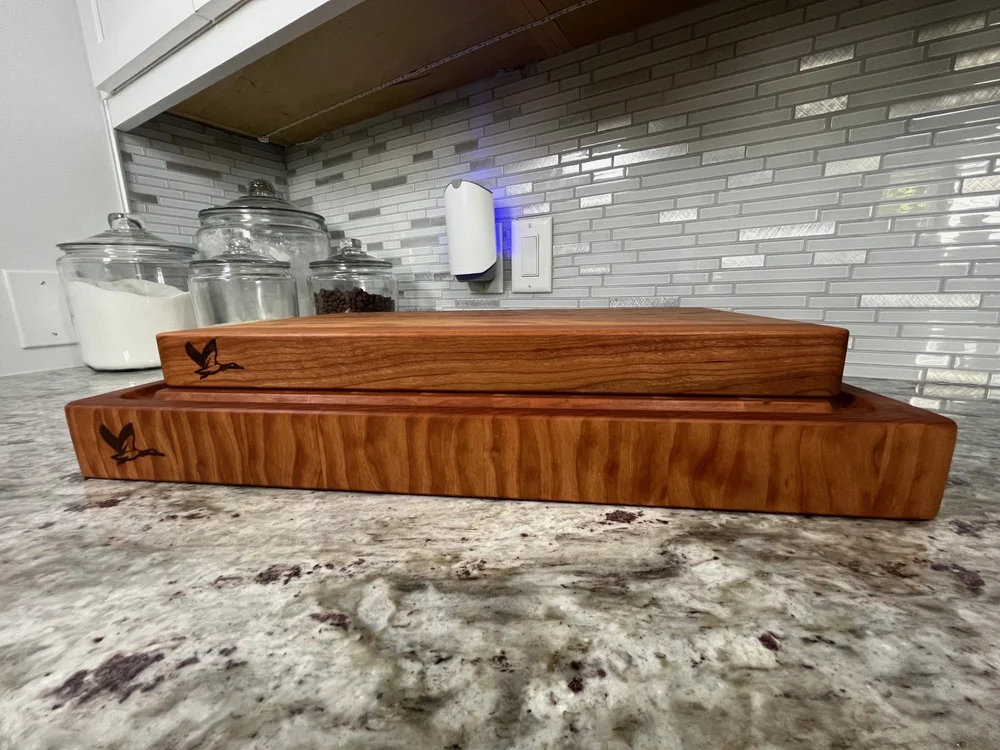
End grain. A common build starts with a glued panel, cuts it into strips, turns the strips so the fiber ends face up, and glues them again. The extra milling, glue-up, and flattening take time. Many makers build these boards thick for a substantial counter surface. Thickness and species determine how heavy the finished board feels.
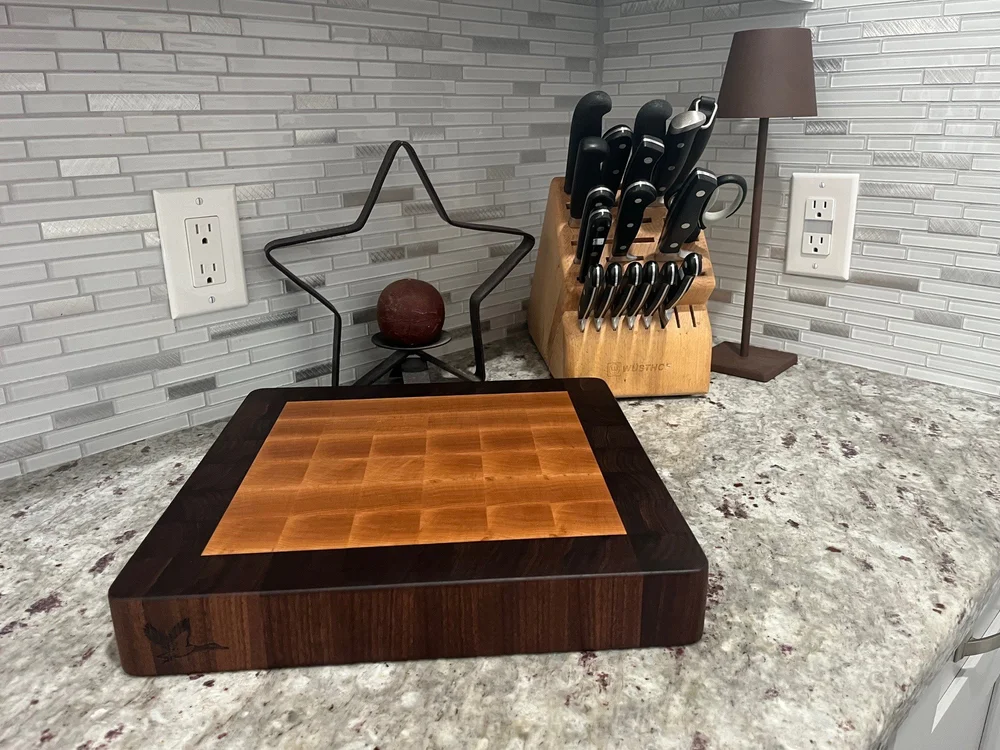
Edge grain. Long strips are turned on edge and glued into a panel. It’s an efficient construction for a thinner, portable prep board. Narrow strips give the maker more control over the appearance and arrangement of the lumber. A well-made edge-grain board can be a daily workhorse.
Face grain. One wide piece or several boards show their broad faces, where figure is often easiest to appreciate. A sound, smooth face-grain board can serve as a cutting surface. Wide pieces deserve particular attention to how they were dried and how they may cup. For a prep board, prioritize flatness, stability, and cleanability.
What about knife edges and “self-healing”?
Board contact can affect blade wear. A controlled kitchen-knife study compared Japanese cypress and plastic and observed different patterns of edge damage. It did not compare end grain and edge grain in the same hardwood. We found no controlled head-to-head evidence strong enough to predict how much longer your knife will stay sharp on end grain. Steel, edge geometry, chopping force, sideways scraping, and what you cut all matter.[13]
With the fibers oriented upward, a shallow knife mark can look less conspicuous against end-grain figure. Wood can compress and some deformation can recover. A cut that severs fibers remains damage. Treat “self-healing” as shop shorthand for how some light marks look. Inspect grooves, cracks, and open seams regardless of grain orientation.[12][14]
Maple, cherry, and walnut
Janka side hardness is the force needed to press a standard steel ball halfway into the side of a wood specimen. It helps compare resistance to indentation. The figures below are Forest Products Laboratory values at 12% moisture content. They describe the wood under a test, and do not predict knife dulling, sanitation, or an exact service life.[14]
| Species | Janka, lbf | What you’ll notice |
|---|---|---|
| Hard maple | 1,450 | Pale, fine-textured, and the most resistant to indentation of these three. Sugar maple is the reference species for this figure. |
| Black cherry | 950 | Warm reddish-brown heartwood that typically deepens with light and age. It dents more readily than maple under comparable loading. |
| Black walnut | 1,010 | Dark brown heartwood, often with strong contrast against pale sapwood. Its side hardness sits closer to cherry than maple. |
Hardness, pore size, and dimensional movement are different properties. On a board you plan to use every day, look for sound stock, a smooth working face, and joints with no open gaps. A hardness number alone cannot settle whether a particular species meets a commercial rule. Maple is expressly named in the FDA model code. For cherry or walnut in a regulated kitchen, check the applicable requirements for that use.[9][12][14]
The details that change daily use
Footprint, thickness, and lifting weight
Measure the counter and the place you’ll wash the board. Allow space for the knife stroke and room to gather chopped ingredients. Check the clear opening of your sink, the distance to the faucet, and how you will grip the board while wet. A board can be excellent on the counter and awkward to clean if it is too wide to turn in the sink.
At the same footprint and wood density, doubling thickness roughly doubles the wood weight before grooves and hardware. A 24 × 18 × 3 in. blank has about 2.3 times the wood volume of a 20 × 14 × 2 in. blank. More mass can make a counter block feel planted, and also makes carrying and drying it more demanding. Added thickness raises the cutting height by the same amount. A tall board can feel different even before you add feet.
Movement and sound joints
Wood exchanges moisture with the air and changes size more across the grain than along it. Radial and tangential movement also differ. Uneven wetting or drying can make one face move relative to the other, contributing to cupping and stress at joints. Exposed end grain often takes up liquid readily. Geometry, species, moisture history, and finishing all matter, so there’s no reliable universal oiling interval tied to grain orientation.[12][15]
Good glue-up starts with sound, conditioned stock and accurately mating surfaces. The maker should follow the adhesive’s directions for the wood, assembly time, clamping, cure, and intended exposure. For example, Titebond identifies its III formulation for cutting boards and indirect food contact, with limits on submersion. A glue manufacturer’s statement applies to that formulation and use. It does not certify the assembled board.[16][17]
Feet, handholds, grooves, and finish
Reversible or footed. Two flat faces give you more usable surface and let you alternate sides. Fixed feet can add grip and airflow beneath a stationary board, at the cost of reversibility and a higher working surface. If a flat board slides, use a clean nonslip mat or a clean, damp towel during prep, then remove it and dry the board.
Handholds and grooves. Recessed handholds make a heavy board easier to lift. A juice groove helps contain runoff from carving, but takes away working area and needs scrubbing. For mostly vegetables, a flat surface lets you sweep ingredients directly into a bowl or pan.
Finish. Food-grade mineral oil sold for board conditioning is a straightforward choice for an oiled board. A board wax formulated for food contact can be buffed on as an optional top treatment. Use the maker’s instructions for any other finish, including curing and suitability for a surface that will see a knife. Keep conditioning separate from cleaning and sanitizing. Oil and wax wear off, and wood can still take up moisture.[18][19]
Wash it, dry it, then let it breathe
- After use. Hand-wash the working face and anywhere that contacted food with hot, soapy water. Give grooves and handholds a scrub. Rinse briefly, remove surface water, and let air reach both faces. After raw meat, poultry, or seafood prep, follow the sanitation guidance in chapter 1.
- Dry and store. Stand the board securely on an edge or use a rack while it dries. Avoid a damp mat, a wet countertop, or prolonged direct heat. Store the board only after it is dry.
- Condition when it needs it. When a clean, dry Green Duck board starts to look dry or feel less smooth, apply a thin coat of food-grade board oil to the faces and edges, allow it to absorb according to the product directions, and wipe away the excess. If using board wax, apply it thinly and buff off any excess. Wash frequency and kitchen conditions determine how often to repeat.
When to keep using it, resurface it, or replace it
Shallow marks and natural color changes are normal. When grooves trap residue, a joint opens, the board rocks under the knife, or you see a crack, take it out of food prep and inspect it. A maker can assess whether a structurally sound board with sufficient thickness can be resurfaced flat and smooth, with any groove or hardware still functional. Contact the maker about open glue joints or serious warping. Replace a board that cannot be restored to a stable, cleanable condition. Avoid filling a food-contact crack with an unspecified household adhesive or filler.[1][9]
Start with how you cook
| Your kitchen | Consider | Check first |
|---|---|---|
| Small sink or limited counter | A compact board around 14 × 10 in., often edge grain | Room for your knife stroke and enough grip to lift it wet |
| Daily prep and frequent washing | A reversible 18 × 12 or 20 × 14 in. board | Usable cutting area, sink clearance, and a place to dry it |
| Dedicated prep station | A thicker 24 × 18 in. block, with end grain if you like the surface and figure | Working height, lifting weight, and a plan for washing and drying |
| Roasts and carving | A large board with a groove and handholds | Capacity for the roast and the full slicing stroke inside the groove |
| Separate raw-protein prep | A visibly different board. Dishwasher-rated plastic is convenient if you use the machine. | Clear assignment and easy cleaning of every surface |
If you’re buying a board as a gift and don’t know the kitchen, a medium footprint and manageable weight are good starting points. For your own kitchen, cut a piece of cardboard to the proposed size and set it where you prep. Leave it there long enough to see what the board will displace.
For examples of how these choices are built, see the walnut and maple edge-grain board, the three-inch black cherry block, or the cutting-board collection.
Furniture-making standards, carried into the kitchen
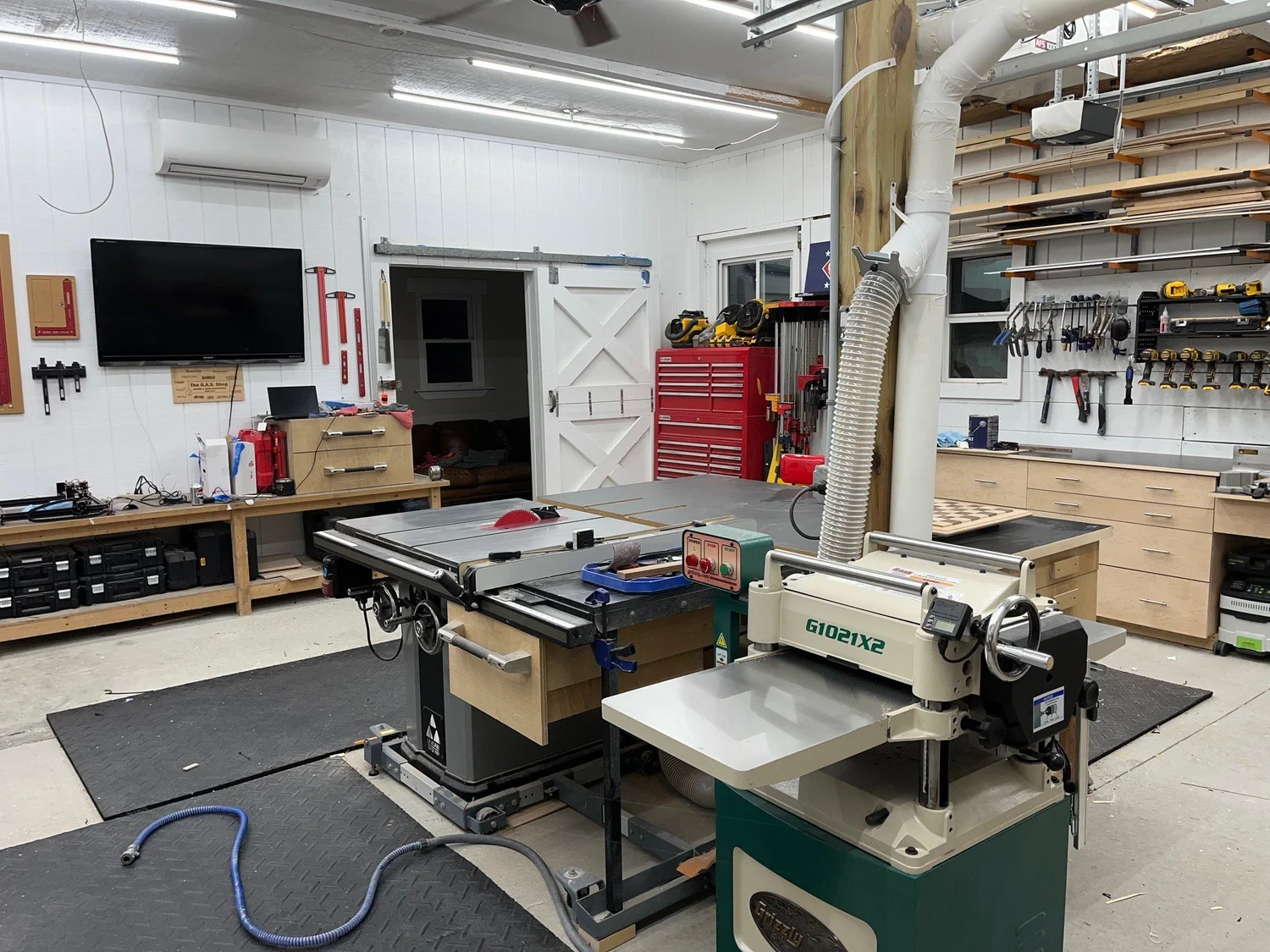
Green Duck started with furniture and custom projects in Hampstead, North Carolina. That work taught us how to select and mill hardwood, fit joints, account for seasonal movement, and check the finished surface under light and by hand. We apply those habits to cutting boards and butcher blocks, down to whether the board lifts cleanly and sits flat on a counter.
We work with hard maple, black cherry, and black walnut for their working properties and natural color. Our board finish uses food-grade mineral oil, beeswax, and carnauba wax. Furniture remains part of the portfolio and is currently sold out while our production is focused on cutting boards.[19][20]
References
- USDA Food Safety and Inspection Service. Should I use a wooden cutting board or a plastic one? Household board selection, cleaning, sanitizing, and replacement.
- FoodSafety.gov. 4 Steps to Food Safety. See “Clean” and “Separate.”
- Ak, N. O., Cliver, D. O., & Kaspar, C. W. (1994). Cutting Boards of Plastic and Wood Contaminated Experimentally with Bacteria. Journal of Food Protection, 57(1), 16–22.
- Ak, N. O., Cliver, D. O., & Kaspar, C. W. (1994). Decontamination of Plastic and Wooden Cutting Boards for Kitchen Use. Journal of Food Protection, 57(1), 23–30.
- Abrishami, S. H., Tall, B. D., Bruursema, T. J., Epstein, P. S., & Shah, D. B. (1994). Bacterial Adherence and Viability on Cutting Board Surfaces. Journal of Food Safety, 14(2), 153–172.
- Miller, A. J., Brown, T., & Call, J. E. (1996). Comparison of Wooden and Polyethylene Cutting Boards: Potential for the Attachment and Removal of Bacteria from Ground Beef. Journal of Food Protection, 59(8), 854–858.
- Welker, C., et al. (1997). Bacterial Retention and Cleanability of Plastic and Wood Cutting Boards with Commercial Food Service Maintenance Practices. Journal of Food Protection, 60(4), 407–413.
- Yadav, H., et al. (2023). Cutting Boards: An Overlooked Source of Microplastics in Human Food? Environmental Science & Technology, 57(22), 8225–8235.
- U.S. Food and Drug Administration. (2026). Food Code 2026. Chapter 4, especially §§ 4-101.17, 4-501.12, 4-602.11, and 4-702.11.
- NSF. Commercial Food Equipment Testing and Certification. Standard scopes and certification overview.
- NSF Official Listings. Examples of an NSF/ANSI 2 finished board listing and an NSF/ANSI 51 materials listing. Verify the exact model when purchasing.
- USDA Forest Products Laboratory. (2021). Structure and Function of Wood. Wood Handbook, FPL-GTR-282, chapter 3.
- Okamura, T., & Takenaka, H. (1979). Studies on Cutting Performance of Kitchen-Knife (Part 7): On the Durability of Cutting Edge of the Kitchen-Knife. Journal of Home Economics of Japan, 30(5), 469–475.
- USDA Forest Products Laboratory. (2021). Mechanical Properties of Wood. Wood Handbook, FPL-GTR-282, chapter 5, Table 5–3b.
- Glass, S. V., & Zelinka, S. L. (2021). Moisture Relations and Physical Properties of Wood. Wood Handbook, FPL-GTR-282, chapter 4.
- USDA Forest Products Laboratory. (2021). Wood Adhesives: Bond Formation and Performance. Wood Handbook, FPL-GTR-282, chapter 10.
- Franklin International. Titebond III Ultimate Wood Glue. Manufacturer technical data and application limits.
- Hunt, C. G. (2021). Finishing Wood. Wood Handbook, FPL-GTR-282, chapter 16.
- Green Duck Custom Furniture & Woodworking. Chef Series Walnut & Maple Edge Grain Cutting Boards. Shop finish and care instructions.
- Green Duck Custom Furniture & Woodworking. Our story and process. Workshop background and materials.